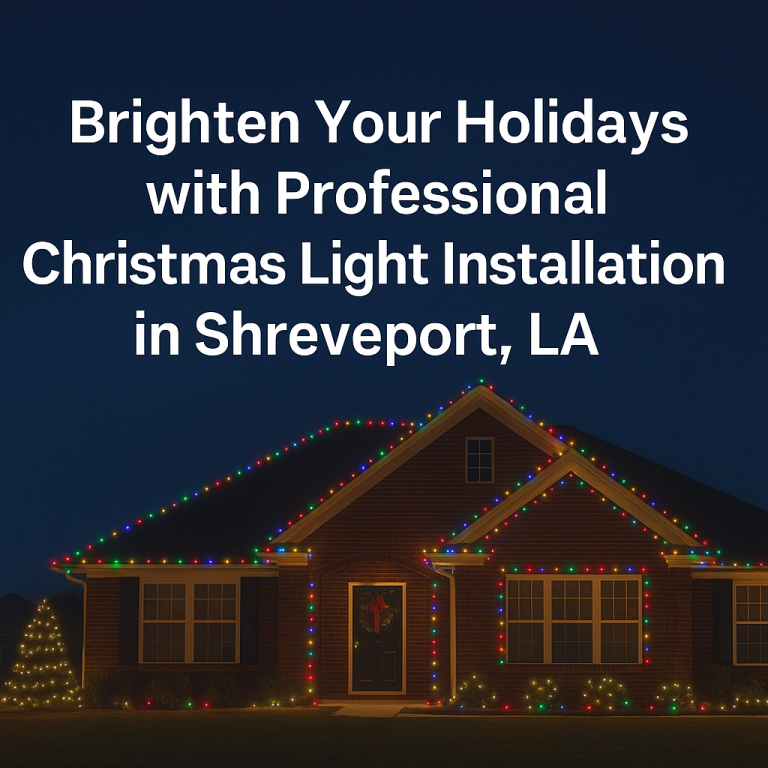
The difference between a house that looks great every December and one that looks like a weekend project comes down to more than the lights.
Every year around mid-October, the same thing happens in Shreveport neighborhoods. A few houses start lighting up in late November looking like they belong on a magazine cover — clean rooflines, uniform spacing, professional-grade color and brightness — and somewhere nearby, a homeowner is on a ladder in 40-degree weather in early December, untangling a box of retail strings from last year, wondering why two sections stopped working.
The gap between those two experiences is not just aesthetics. It is equipment, planning, electrical safety, and timing. Here is what professional Christmas light installation actually involves, what makes it different from a DIY display, and why October is the month to get on the schedule if you want your Shreveport home looking its best this December.
What “Commercial Grade” Actually Means
Every professional installation company uses the phrase “commercial grade lights.” Most never explain what that means. It is worth understanding, because it is the most significant difference between a professional display and what you buy at a big box store.
Retail Christmas lights sold at hardware stores and home improvement chains are typically rated for 1,500 to 2,500 hours of use. At eight hours per night over a 45-night holiday season, that is roughly three to five seasons before you can expect significant bulb failure and connector degradation. Most homeowners experience it sooner, because retail-grade connectors are not built for outdoor exposure in a humid climate like Shreveport’s.
Commercial-grade C9 and C7 LED bulbs, the type used in professional installations, are typically rated for 25,000 to 50,000 hours. That translates to more than 60 seasons at the same usage rate. The connectors are weatherproofed to a higher standard, the wire gauges are heavier, and the sockets are built to handle repeated installation and removal without degrading.
The energy difference is also substantial. A standard incandescent C9 bulb draws approximately 7 watts. A commercial-grade LED C9 draws roughly 0.5 watts. On a 150-foot roofline with bulbs spaced every 12 inches, that is 150 bulbs. Incandescent at that count pulls around 1,050 watts per hour. LED pulls about 75 watts per hour. Running eight hours a night for 30 nights, the incandescent setup consumes roughly 250 kilowatt-hours for the season. The LED setup consumes about 18. At Louisiana’s typical residential electricity rate, that difference shows up on your December and January bills.
Brightness and color consistency are also different categories. Commercial-grade LEDs are binned tightly, meaning all the warm white bulbs in a display are the same actual color temperature. Retail strings from the same package can vary noticeably because the binning standards are looser. On a roofline, that inconsistency is visible from the street.
How the Installation Process Works
The Consultation and Design
A professional installation starts with a property walkthrough, not a truck pulling up and starting to hang lights. The walkthrough covers the home’s roofline configuration, fascia and gutter type, access points, and existing outdoor electrical.
Roofline design is more involved than it looks from the ground. The linear footage of the eave has to be measured precisely, the number of outlets and their locations determine how the circuits are run, and the pitch and material of the roof affect how installers access and fasten the display. A ranch home in Benton with a single-story roofline and a brick fascia is a completely different project from a two-story Craftsman in South Highlands with wood fascia and a steeper pitch.
This walkthrough is also when the design is decided: roofline wrapping, window and door framing, tree wrapping, pathway lighting, wreath and garland placement. Good installation companies build a diagram and a quote from this walkthrough rather than estimating over the phone.
The Installation Itself
Once the design is confirmed and scheduled, installation day typically takes two to four hours for a standard single-story residential display, longer for larger properties or multi-story homes. Installers work from the ground when possible and use ladders and roof access where necessary, following fall protection protocols.
Clips and fasteners are matched to your specific fascia type. Aluminum fascia, wood fascia, and gutters each require a different attachment method. Using the wrong clip type for a surface is one of the most common reasons DIY installations look uneven or cause minor damage to gutters over time.
All connections are sealed for outdoor use and electrical runs are managed to avoid overloading any single circuit.
Takedown and Storage
Removal at the end of the season is part of the service. Lights are taken down carefully, tested, wound onto storage reels, and stored properly rather than bundled into a box. That is how the same display can go back up the following year looking exactly as it did in year one — lights inspected, connectors intact, the design already on file.
This is the part of professional installation most homeowners undervalue when they first consider it. The accumulation of tangled, partially working retail strings in a garage is a problem that compounds every year. Professional lights stored correctly do not have that problem.
The Electrical Side Nobody Talks About
Outdoor Christmas displays are electrical systems, and in Shreveport’s climate, that side of the installation deserves serious attention.
The National Electrical Code (NEC 210.8) requires GFCI protection for 15- and 20-amp, 125-volt outdoor receptacles. GFCI outlets are the ones with the test and reset buttons, and they are the code-required protection that trips before an electrical fault becomes a fire or a shock hazard outside. Any professional installation should be running through GFCI-protected circuits. If your home’s outdoor outlets are older and not GFCI-protected, a professional installer will identify that during the walkthrough.
Extension cord gauge matters on longer runs. A 16-gauge cord handles runs up to about 50 feet safely at normal residential load. Beyond 50 feet, a 14-gauge cord is appropriate. Beyond 100 feet, 12-gauge. Undersized cords for the run length create resistance, heat, and over time, hazard. This is one of the most common DIY electrical mistakes in outdoor holiday displays.
Circuit load is the other variable. A standard 15-amp residential circuit should not be loaded past 80 percent of its capacity, which is about 1,440 watts. Commercial-grade LED displays draw so little current that circuit loading is rarely a concern. Incandescent displays on older homes with limited outdoor circuits can run into this quickly.
Shreveport’s humidity adds a layer to all of this that does not apply in drier climates. Moisture ingress into unsealed connectors is the primary cause of outdoor light failure in the South. Commercial-grade connections are weatherproofed. A professional installation in Shreveport accounts for humidity in a way that a retail display strung over a weekend does not.
Why Booking in October Changes Everything
Professional Christmas light installation in Shreveport is not a December service. By the time most homeowners start thinking about holiday lighting, quality installation companies are fully booked.
The booking pattern runs predictably every year. Installation companies open their schedules in early October. The first wave of bookings comes from returning clients and early-decision homeowners in mid-October. By early November, the most desirable installation windows — the ones that get your display up before Thanksgiving — are gone. By Thanksgiving week, most professional crews have a full December calendar and are managing a waitlist.
Shreveport’s mild winter does mean installations can physically happen later than in northern markets. But “physically possible in December” and “actually available in December” are two different things. The crews capable of doing professional-quality work on a tight schedule book up well before December arrives.
The other reason October matters: a booking now means your display design is settled, your crew has walked your property, and installation happens on a schedule that gives you the full season rather than a compressed few weeks.
Why It Matters That We Already Know Your Property
Most Christmas light companies are showing up to your home for the first time. They are learning your roofline, finding your outdoor outlets, and figuring out your property in real time on installation day.
Lawn Care Experts has been on your property all season. We know where your outdoor electrical access is, how your roofline is configured, where the irrigation runs near the foundation, and how to navigate your yard without causing damage. That is not a minor thing when a crew is carrying ladders and running electrical across a property they have never seen.
It also means the person who answers your question in October is the same company you have already been working with. Not a seasonal crew staffed up for December.
Get on the Schedule Before It Fills Up
We are currently scheduling Christmas light installation appointments for the Shreveport, Bossier City, Benton, Stonewall, and surrounding northwest Louisiana area. Spots are limited and we book on a first-come, first-served basis.
Call us at (318) 272-2080 or request a free consultation online. We will walk your property, put together a design and quote, and lock in your installation date before the calendar fills.
Frequently Asked Questions
When do you start installing Christmas lights in Shreveport?
We begin installations in late October and continue through November, with limited December availability. October and early November bookings get the best scheduling windows and the most flexibility on installation date.
Do the lights stay up if it rains or there is a storm?
Yes. Commercial-grade outdoor displays are built for exterior use and are weatherproofed for the conditions they will experience through the season. Shreveport’s December weather, including rain, humidity, and occasional cold snaps, is within the design range of the equipment we install. If there is ever a weather-related issue with a display after installation, we address it.
Can you match lights I already have from a previous professional installation?
Potentially, depending on the manufacturer and bulb type. We will assess during the consultation. In most cases, starting with a consistent set of our commercial-grade lights produces better results than mixing product lines, but we will walk through the options during your property visit.
What happens to the lights at the end of the season?
We return to take everything down, test the lights, wind them onto reels, and store them properly. Your display is documented so the following year’s installation is faster and consistent with what you had the previous season.
Is professional installation worth it for a smaller home?
The value is not just about display size. It is about equipment quality, electrical safety, and not spending your own time on a ladder in December. Even a modest, clean roofline display done with commercial-grade LEDs looks more finished than a larger DIY display with retail strings that fade and burn out unevenly. The consultation is free and there is no obligation, so the best way to answer that for your specific property is to let us take a look.
Do you install lights on commercial properties?
Yes. We work with residential and commercial properties throughout the Shreveport metro. Commercial installs are quoted separately based on the property size and scope.
Need Help With Your Lawn?
Get a free, no-pressure estimate for lawn care, landscaping, irrigation, fertilization, or Christmas light installation in Shreveport and Bossier City.